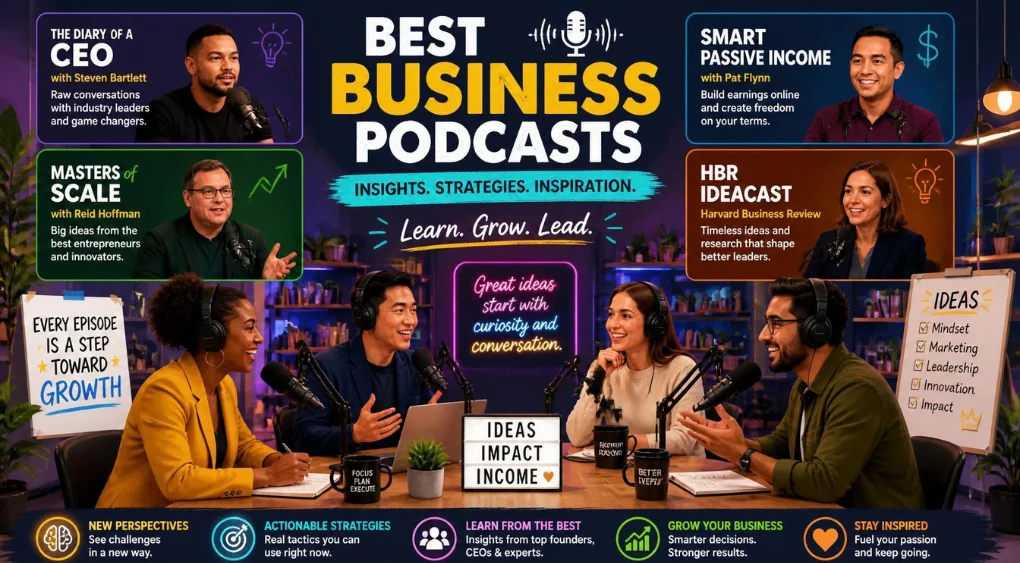
The best business podcasts can turn commute time into useful lessons on strategy, leadership, marketing, and company building. The challenge is choosing shows that match your current goals. This guide ranks ten active options for U.S. listeners using usefulness, depth, accessibility, and topic range.
The strongest shows serve different needs. Start with How I Built This for founder stories, Acquired for company strategy, My First Million for ideas, HBR IdeaCast for management, and Planet Money for economic context. Pick two or three that match your current goal, then apply one useful lesson each week.
| Rank | Podcast | Best for | Typical format |
| 1 | How I Built This | Founder stories and business fundamentals | Narrative founder interviews |
| 2 | Acquired | Company strategy and competitive advantage | Long company case studies |
| 3 | My First Million | Business ideas and opportunity spotting | Co-host discussions and interviews |
| 4 | HBR IdeaCast | Leadership and management | Weekly expert conversations |
| 5 | Planet Money | Economics and business context | Reported explainers and stories |
| 6 | Lenny’s Podcast | Product, growth, and technology | Tactical expert interviews |
| 7 | Masters of Scale | Scaling companies and teams | Founder and executive interviews |
| 8 | The $100 MBA Show | Short practical lessons | Focused tactical episodes |
| 9 | Morning Brew Daily | Business news and current events | Fast news discussion |
| 10 | The Diary Of A CEO | Long-form leadership and founder conversations | Extended interviews |
Key takeaways
- Choose by your current problem, not a universal ranking.
- Start with two or three shows, then build a small listening routine.
- Use founder stories for judgment, tactical shows for execution, and news shows for context.
- Current popularity can signal reach, but it does not guarantee relevance to your business.
- Apply one idea after each useful episode instead of collecting endless advice.
How we ranked these shows
Best Business Podcasts Our ranking favors practical learning, clear formats, active publishing, and relevance to U.S. business listeners. Popularity matters, but it doesn’t determine the order. Apple and Spotify business charts can show different leaders, which makes one-day rankings a weak sole measure.
Best Business Podcasts Ranked for U.S. Listeners
1. How I Built This: best overall for founder stories
How I Built This is our top pick for listeners who want business lessons through memorable founder stories. Guy Raz interviews entrepreneurs about growth, setbacks, leadership, and difficult decisions. The format works for beginners because the story gives each lesson clear business context.
- Pros: Accessible storytelling, recognizable founders, strong lessons on resilience and decision-making.
- Cons: Storytelling can be less tactical than shows focused on immediate operating playbooks.
If you are building your first venture, pair these stories with Bussinify’s guide to starting a business with no money. Founder interviews become more useful when you compare them with your own constraints. That approach turns inspiration into a practical checklist.
2. Acquired: best for deep company strategy
Acquired studies major companies in unusually long, heavily researched episodes. Hosts Ben Gilbert and David Rosenthal focus on business models, strategic choices, competition, and company history. It suits listeners who enjoy detailed case studies and can commit several hours.
- Pros: Exceptional depth, strong strategic context, and useful company-history analysis.
- Cons: Episodes take longer than most commuting or daily-learning formats.
This show works best when you want to understand why a company became durable. It can sharpen your thinking about positioning, distribution, pricing power, and competitive advantage. Take notes on one strategic decision instead of trying to remember every detail.
3. My First Million: best for business ideas
My First Million features Sam Parr and Shaan Puri discussing business ideas, trends, and market opportunities. Their conversations often examine how an idea could attract customers or generate revenue. The energetic format suits founders who enjoy brainstorming and pattern recognition.
- Pros: High idea volume, entertaining chemistry, and frequent examples of market opportunities.
- Cons: Not every idea fits every industry, budget, or risk tolerance.
Use the show as an idea generator instead of a business plan. Test each promising concept against customer demand, costs, and your own skills. Bussinify’s article on common entrepreneur myths can also help separate excitement from unrealistic assumptions.
4. HBR IdeaCast: best for leadership and management
HBR IdeaCast is a weekly Harvard Business Review show about business and management. Its conversations focus on leadership, organizational problems, decision-making, and current workplace challenges. Managers can use it to improve how they lead teams and structure decisions.
- Pros: Credible management focus, clear expert perspectives, and strong workplace relevance.
- Cons: The tone can feel more formal than founder-led shows.
This is a useful choice for owners moving from solo work into people management. Team problems often require different skills than customer acquisition or product development. Bussinify’s business management resources can extend that learning into related workplace topics.
5. Planet Money: best for understanding the economy
Planet Money explains economic forces through stories, examples, and reported episodes. The show connects everyday events with prices, incentives, labor, trade, and business behavior. It is especially useful when economic headlines feel too abstract or technical.
- Pros: Beginner-friendly explanations, broad economic context, and strong storytelling.
- Cons: Less focused on step-by-step entrepreneurship tactics.
Business owners still need context beyond their own company. Interest rates, consumer behavior, labor conditions, and industry shifts can change business decisions. A strong economics show helps you ask better questions before reacting to headlines.
6. Lenny’s Podcast: best for product and growth
Lenny’s Podcast features Lenny Rachitsky interviewing product leaders, founders, and growth experts. Episodes focus on product strategy, growth systems, leadership, and building technology products. It is particularly useful for software founders, product managers, and growth teams.
- Pros: Tactical conversations, strong product focus, and detailed lessons from experienced operators.
- Cons: Some episodes assume familiarity with technology companies and product-management language.
Choose this show when your main questions involve product-market fit, retention, growth, or product leadership. It may feel narrow for local retail or traditional service businesses. Technology-enabled companies will find more directly transferable examples.
7. Masters of Scale: best for growth-stage founders
Masters of Scale focuses on how founders and executives grow companies, teams, and operating systems. The show covers scaling decisions, leadership challenges, innovation, and expansion through executive conversations. It fits listeners who already have traction and want to manage growth.
- Pros: Strong growth-stage focus, experienced guests, and lessons about organizational scale.
- Cons: Early-stage founders may find some problems larger than their current needs.
Scaling advice becomes useful only after a business has repeatable demand. Before copying a large-company tactic, check whether your customer base and team need it. Bussinify’s guide to supporting small businesses offers broader context on common constraints facing smaller firms.
8. The $100 MBA Show: best for short practical lessons
The $100 MBA Show gives listeners short, focused lessons from entrepreneur Omar Zenhom. Topics include validation, marketing, sales, audience building, and reinvestment. The compact format works well for owners who want one practical concept without a long interview.
- Pros: Short episodes, clear topics, and practical small-business orientation.
- Cons: Short lessons cannot explore every issue with deep case-study detail.
This format is useful when your calendar is crowded. Listen with one specific business question, then write down one action after the episode. Small lessons become more valuable when they change something you do that week.
9. Morning Brew Daily: best for business news
Morning Brew Daily covers current business and economic news with hosts Neal Freyman and Toby Howell. The show gives listeners a quick way to follow major stories affecting companies and markets. It suits professionals who want regular context without reading several news sources first.
- Pros: Timely coverage, conversational delivery, and broad business-news range.
- Cons: News ages quickly and may not produce evergreen operating lessons.
Use news podcasts to understand context, not to rebuild your strategy every morning. Track stories that directly affect customers, costs, hiring, regulation, or competitors. Ignore stories that create urgency without changing a decision you control.
10. The Diary Of A CEO: best for long-form leadership conversations
The Diary Of A CEO features Steven Bartlett in extended conversations with founders, leaders, experts, and other notable guests. Business, performance, personal development, and leadership often overlap within the same interview. The broad format fits listeners who prefer long conversations over narrow tactical lessons.
- Pros: Wide guest range, long-form conversations, and strong popularity across business podcast charts.
- Cons: The broad subject mix means some episodes are only partly focused on business.
This show currently has major reach in U.S. business listening charts, but popularity is not our ranking method. Choose episodes by guest and topic instead of trying to follow every release. That filter keeps the time investment aligned with your business priorities.
How to choose the right show for your goals
Start with the business problem that matters this month. Choose founder stories for judgment, tactical shows for execution, and news shows for external context. If your team works remotely, Bussinify’s guide to flexible work-from-home schedules can support people-management decisions.
A good show works when listening changes your behavior. Keep a simple note with the problem, idea, and next action from each episode. Review those notes weekly and discard advice that does not fit your customers or resources.
A simple two-podcast listening plan
Choose one show that matches your operating problem and one that broadens your perspective. For example, pair The $100 MBA Show with Planet Money for tactics plus economic context. A product leader could pair Lenny’s Podcast with Acquired for execution plus long-term strategy.
Keep the routine small enough to finish what you start. Two or three episodes each week can provide plenty of material for testing ideas. Adding more subscriptions often creates a queue, not better decisions.
Turn listening into action
A good podcast queue should support decisions, not become another content backlog. Pick one show from this list and connect its lessons to a current business problem. Then explore Bussinify’s small-business resources when you need a practical next step beyond the episode.
Frequently asked questions
- What are the best business podcasts for beginners?
- How I Built This and Planet Money are strong starting points because both explain ideas through stories. The $100 MBA Show also works well for short practical lessons. Choose one broad show and one tactical show before adding more.
- Which podcast is best for entrepreneurs looking for ideas?
- My First Million is the clearest choice on this list for business brainstorming. Its hosts regularly discuss trends, opportunities, and possible business models. Treat each concept as a hypothesis that still needs customer research.
- Which show is best for leadership and management?
- HBR IdeaCast is our strongest management-focused pick because it centers on leaders and workplace problems. Masters of Scale is more useful for growth-stage leadership questions. Your company size should guide the choice.
- Can you learn business from podcasts?
- Yes, podcasts can expose you to examples, frameworks, and decisions from experienced operators. Listening alone doesn’t build business skills. Learning becomes more valuable when you test one relevant idea in real work.
- How many shows should you follow?
- Start with two or three active subscriptions. Give each show several episodes before deciding whether it deserves a regular place. Drop anything that rarely connects with decisions you actually make.