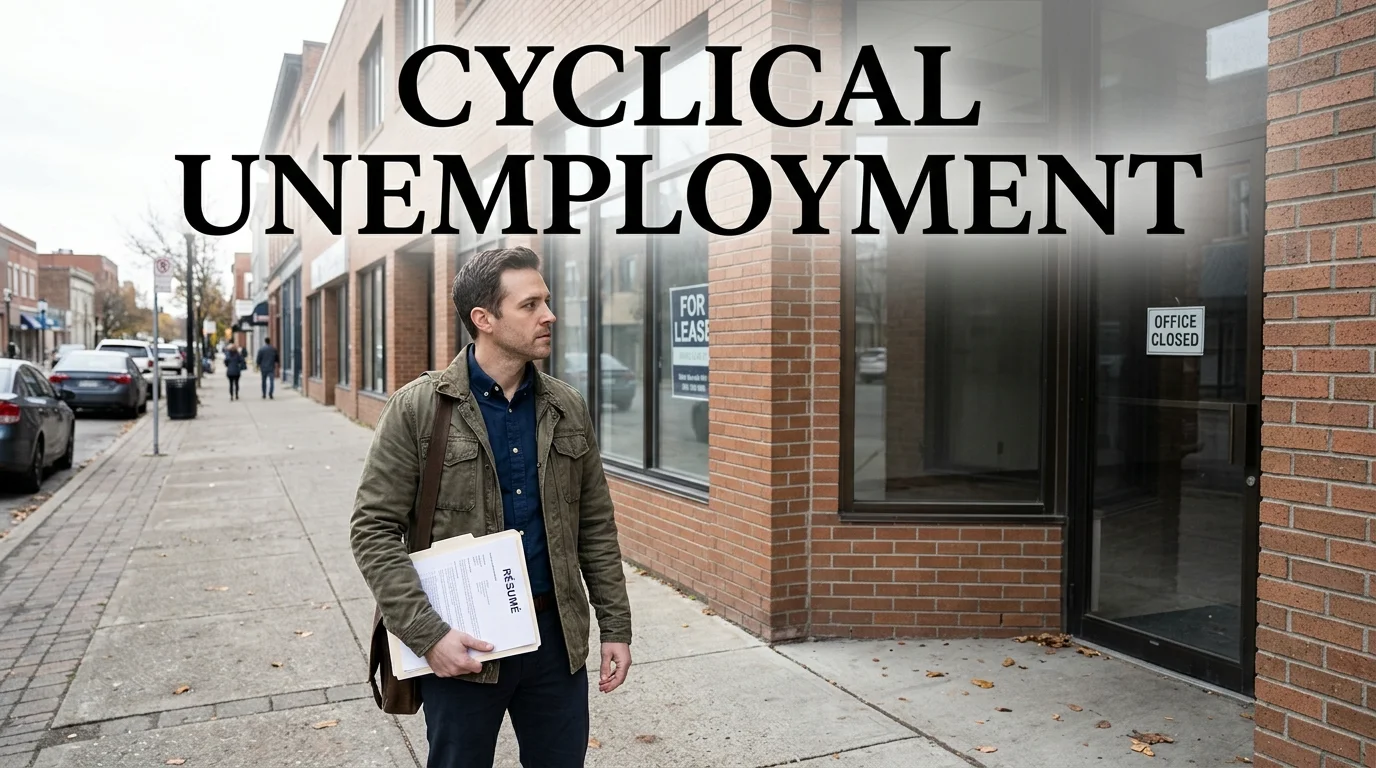
Cyclical unemployment is joblessness caused by downturns in the business cycle. It rises when economic activity weakens and businesses need fewer workers. It usually falls again when consumer demand, production, and economic growth recover.
For American workers and businesses, this type of unemployment helps explain why layoffs can spread during recessions. Workers may have suitable skills, yet employers still reduce staffing because sales have fallen. Understanding that distinction makes economic news and labor-market changes easier to interpret.
| Key Point | What It Means |
|---|---|
| Main cause | Falling demand during an economic downturn |
| Common during | Recessions and periods of weak economic growth |
| Direction | Rises during contractions and falls during expansions |
| Workers’ skills | Usually not the main cause of job loss |
| Related concept | Business cycle |
| Different from | Structural, frictional, and seasonal unemployment |
| Common response | Fiscal or monetary measures that support economic activity |
Direct answer: It occurs when an economic downturn reduces demand for goods and services. Businesses respond by lowering production, delaying expansion, or cutting jobs. As the economy recovers, spending generally rises, companies need more workers, and this portion of unemployment tends to decline.
What Is Cyclical Unemployment?
The term describes unemployment connected to expansions and contractions in the economy. The Federal Reserve Bank of St. Louis describes it as unemployment associated with recessions and deviations from the natural unemployment rate. It therefore reflects broader economic conditions rather than one worker’s qualifications.
Think about a construction company during a broad housing downturn. Customers postpone projects, developers build fewer properties, and contractors receive less work. The company may lay off skilled employees even though those employees remain capable of doing their jobs.
The same pattern can occur across retail, manufacturing, hospitality, transportation, and other demand-sensitive industries. A decline in spending can reduce company revenue across several sectors. Employers then adjust hiring, hours, investment, and staffing to match weaker demand.
How It Follows the Business Cycle
Economic activity doesn’t remain at one level forever. Periods of expansion can bring rising production, stronger sales, investment, and increased hiring. Contractions can reverse those conditions and weaken demand for labor.
During an expansion, households often have higher incomes and businesses see more customer demand. Companies may increase production and hire employees to meet that demand. Falling unemployment can accompany this stage when employers compete for available workers.
During a contraction, households and companies may become more cautious about spending. Lower demand can leave businesses with excess capacity or weaker sales. As a result, employers may freeze hiring, reduce hours, or eliminate positions.
This relationship explains the word “cyclical.” The unemployment comes from changes associated with the economic cycle rather than permanent disappearance of every affected occupation. OpenStax similarly describes it as unemployment variation as an economy moves between expansion and recession.
What Causes It?
A decline in overall demand is a central cause. When consumers buy fewer products and services, companies receive less revenue. Businesses may then require fewer employees to produce or deliver what customers want.
Several events can contribute to weaker economic activity. Financial crises can restrict borrowing, while falling confidence can encourage households to postpone major purchases. Higher financing costs can also make businesses reconsider expansion plans and investments.
The effect can become self-reinforcing during a serious downturn. Businesses cut jobs because customers are spending less. Newly unemployed workers then have less income available for purchases, adding further pressure to consumer demand.
Business conditions don’t affect every industry equally. Companies selling expensive or discretionary products may experience sharp changes when customers become cautious. Essential services can sometimes face smaller demand changes, although no sector is automatically protected from every downturn.
How It Compares to Structural and Frictional Unemployment
Not every unemployed worker lost a job because of a recession. Economists separate unemployment into categories because the underlying causes differ. Those differences also influence which economic or labor-market responses may help.
| Type | Main Cause | Simple Example | Usually Improves With Economic Recovery? |
|---|---|---|---|
| Cyclical | Weak economy and lower demand | Factory reduces staff during a recession | Often |
| Structural | Skills or jobs no longer match | Worker lacks skills required by new technology | Not necessarily |
| Frictional | Normal job searching or transitions | Employee leaves one job while seeking another | Not directly |
| Seasonal | Predictable seasonal changes | Seasonal resort reduces staff after peak season | Returns with the season |
Structural unemployment involves a mismatch between available jobs and workers’ skills, experience, or location. A recovery alone may not solve that mismatch. Workers may need retraining, relocation, or experience in a growing occupation.
Frictional unemployment is different because it comes from normal movement within the labor market. Someone may leave a position and spend several weeks searching for a better opportunity. New graduates entering the workforce can also experience this temporary job-search period.
The St. Louis Fed identifies frictional and structural unemployment as components of natural unemployment. It describes the cyclical component as the deviation from that natural rate. This framework helps economists separate recession-related weakness from longer-lasting labor-market factors.
How Is It Calculated?

There isn’t a separate monthly government statistic labeled specifically as this rate. The U.S. Bureau of Labor Statistics publishes unemployment measures based on household survey data. Economists then use estimates of natural unemployment and other indicators to assess cyclical weakness.
A simplified classroom formula is:
Cyclical rate = actual unemployment rate − natural unemployment rate
Suppose the actual unemployment rate is 7%, while economists estimate the natural rate at 4.5%. The simplified cyclical component would equal 2.5 percentage points. This calculation helps illustrate the concept, although estimating the natural rate precisely is more complicated.
The natural rate itself isn’t directly observed like a store price or payroll number. Economists estimate it using labor-market and economic data. For that reason, calculations of the cyclical component can vary depending on the assumptions and model used.
Examples in the United States
The Great Recession provides a clear American example. The downturn officially lasted from December 2007 through June 2009, while employment weakness persisted beyond the recession’s formal end. Falling housing activity, financial stress, and weaker demand affected jobs across numerous industries.
Construction illustrates the mechanism clearly. When demand for new homes and commercial projects falls, builders need fewer crews. Carpenters, equipment operators, sales staff, and other employees can lose work even though their occupational skills haven’t suddenly disappeared.
The 2020 pandemic downturn created another dramatic labor-market shock, although its causes were unusual. Business restrictions, health concerns, and abrupt spending shifts affected employment across the country. The Bureau of Labor Statistics documented the pandemic’s extensive effects on employment and unemployment statistics.
These examples also show why real economies don’t fit perfectly into one category. A downturn may initially create cyclical job losses, while lasting changes later create structural problems. Economists therefore examine several indicators before assigning a single explanation to labor-market weakness.
Why It Matters to Businesses
Weak demand can force companies to reconsider staffing before they know how long a downturn will last. Payroll is a major expense for many employers, so falling revenue can create difficult decisions. Businesses may freeze hiring or reduce employee hours before resorting to larger layoffs.
Small companies can face particular pressure because they may have less financial room to absorb a long sales decline. Cash reserves, access to financing, customer concentration, and fixed expenses can affect their resilience. Bussinify’s guide to supporting small businesses provides additional context on small-business challenges and their role in employment.
Employers can also respond without immediately eliminating positions. Some delay new projects, reduce overtime, leave vacant positions unfilled, or shorten work schedules. These choices show why unemployment statistics provide only one view of labor-market conditions.
Work arrangements can change as companies adjust costs and staffing models. Flexible schedules and remote arrangements may influence how some organizations structure their workforce. Bussinify also covers flexible work-from-home hours and their implications for employees and employers.
How Does It Affect Workers?
The most obvious effect is lost income. Workers who lose jobs may reduce discretionary spending and postpone large purchases. That reaction is understandable for individual households, but widespread spending cuts can further weaken demand.
Job searches can also become more difficult during broad downturns. A worker isn’t competing only with people leaving individual companies. Multiple employers may be reducing staff while fewer businesses are adding positions.
Workers can prepare by maintaining an emergency fund where possible and keeping professional skills current. Building contacts before a downturn can also make future job searches easier. These steps cannot prevent a recession, but they can improve personal financial and career flexibility.
How Can It Decline?
The most direct path is a recovery in economic demand. When households buy more, businesses receive more orders and need additional production. Employers can then increase hours, reopen positions, and hire more workers.
Fiscal policy can support economic activity through government spending or tax measures. Monetary policy can also influence borrowing conditions and broader demand. The effectiveness and side effects of specific policies depend on inflation, financial conditions, and the cause of the downturn.
Recovery isn’t always immediate. Employers may wait for stronger evidence that demand will continue before committing to permanent hiring. This lag helps explain why workers can still face a difficult labor market after broader economic indicators begin improving.
Signs That Unemployment May Be Cyclical
No single statistic proves that all joblessness is cyclical. Economists instead examine unemployment alongside production, consumer spending, hiring, business investment, and other measures. A broad weakening across these indicators can suggest that the business cycle is affecting employment.
Industry patterns can provide additional clues. Layoffs spread across demand-sensitive industries during many contractions. A problem concentrated in one occupation or industry may point more strongly toward structural change.
The BLS also seasonally adjusts many labor-market measures. Seasonal adjustment removes recurring patterns associated with factors such as holidays, weather, and school schedules. That process makes broader cyclical trends easier to observe.
Frequently Asked Questions About Cyclical Unemployment
What is cyclical unemployment in simple terms?
It means people lose jobs because the economy has weakened. Businesses have fewer customers or orders, so they need fewer workers. Employment tends to recover as economic activity and demand improve.
What is the main cause?
The main cause is insufficient demand during an economic contraction. Lower spending reduces business sales and production needs. Employers then may reduce hiring, hours, or staffing.
What is an example of it?
A construction worker laid off because a recession sharply reduces new building projects is a common example. The worker still has useful construction skills. The immediate problem is insufficient demand for projects and labor.
What is the difference between cyclical and structural unemployment?
It comes mainly from weak economy-wide demand. Structural unemployment comes from mismatches involving skills, locations, technologies, or available jobs. Economic recovery can reduce the first problem without necessarily fixing the second.
Is it part of the natural rate of unemployment?
Economists generally don’t include it in the natural rate. The natural rate reflects unemployment that remains when the economy isn’t suffering from cyclical weakness. Frictional and structural factors are commonly included in that concept.
Does it happen only during recessions?
It is most strongly associated with recessions and economic contractions. Cyclical weakness can begin as growth slows before a recession is formally identified. Likewise, employment can remain weak during the early stages of a recovery.
The Bottom Line
Cyclical unemployment connects the labor market directly to the ups and downs of economic activity. When demand falls, businesses can cut production and jobs even when workers remain qualified. When demand recovers, many of those employment opportunities can return.
Understanding the concept helps workers, business owners, and investors read economic conditions more carefully. A rising unemployment rate doesn’t automatically mean workers suddenly lack useful skills. Sometimes the central problem is simply that the economy isn’t generating enough demand for their labor.
For business owners, the practical next step is to watch demand, cash flow, staffing needs, and broader economic indicators together. No single measure tells the whole story. Combining those signals can support better hiring and workforce decisions across different stages of the business cycle.